The award
The Davy Medal is awarded for outstanding contributions in the field of chemistry. The medal is named after Humphry Davy FRS, the chemist and inventor of the Davy Lamp, and was first awarded in 1877. The medal is of bronze, is awarded annually and is accompanies by a gift of £2,000.
Eligibility
The Davy medal is open to UK/Commonwealth/Republic of Ireland citizens or those who have been residents for three or more years. There are no restrictions on career stage and nominations will remain valid and shall be considered by the award selection committee throughout three nomination cycles. Teams or groups may now be nominated for this award.
Nominations are open
Nominations are now open and will close on 20 February 2026.
Spotlight on 2025 winner
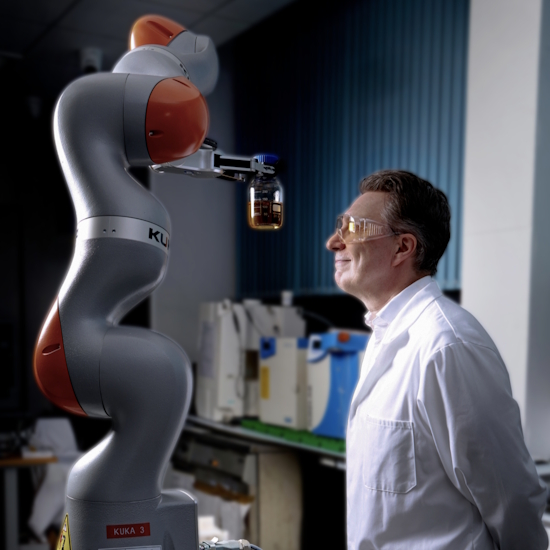
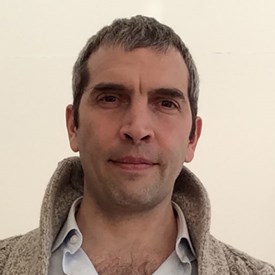
Professor Andrew Cooper FRS was awarded the Davy Medal in 2025. He is Director of the Materials Innovation Factory (MIF) and the Leverhulme Research Centre for Functional Materials Design. He is Co-Director of AIchemy, the Engineering and Physical Sciences Research Council (EPSRC) hub for AI in chemistry.
Professor Cooper’s research is at the interface of chemistry, robotics and artificial intelligence (AI).
Speaking about his research, Professor Cooper said:
“In 2020, we built the world’s first ‘mobile robotic chemist’, a robot that can carry out chemistry experiments, making its own decisions about what to do next. This robot is more than 200 times faster than manual approaches because it works 24/7 and makes almost instantaneous decisions, allowing it to do the equivalent of a PhD’s-worth of experiments in a week.”
Responding to winning the Davy Medal, Professor Cooper said:
“I hope this prize will raise the profile of our work and lead to new partnerships and collaborations, for example with teams working on next-generation large language models (LLMs) and artificial intelligence (AI) technologies.
This prize reflects the work of a diverse team of collaborators over many years who have believed in the long-term value of creating new digital approaches to chemistry research. This can be a hard path, particularly in the early stages, and I am fortunate to have had colleagues who were not afraid to pursue speculative and risky ideas.”