Philosophical Transactions B recently published a theme issue on ‘Transforming cultural evolution research and its application to global futures’. In this blog, Guest Editor Professor Rachel Kendal (Durham University) tells us how this issue came about, and about some of the important research highlighted in this issue.

Tell us about the idea behind this theme issue and how it came about.
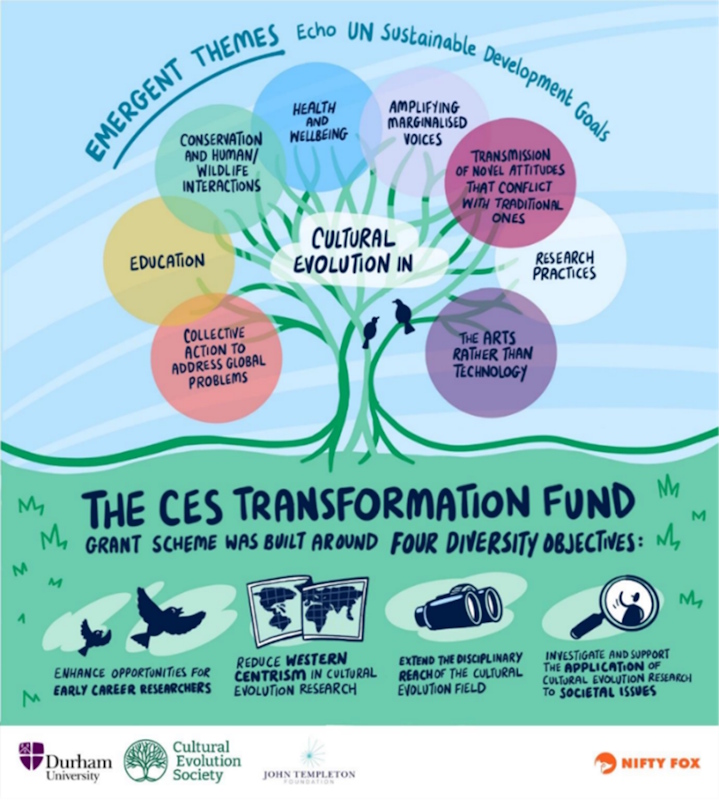
As we write in the introduction article, the field of cultural evolution has dramatically expanded in recent decades meaning it is time to take stock of its accomplishments but also address the challenges it faces. The theme issue is a product of the Cultural Evolution Society Transformation Fund. This is a grant scheme which I was privileged to design and run specifically to diversify the field of cultural evolution and encourage cultural evolution’s application to global futures. Through the grant scheme’s funding processes and research calls we explicitly invited a diverse range of disciplines and researchers to engage with the field of cultural evolution to address how societies can adapt to pressing societal issues of our time. Crucially, this initiative drew in under-represented researchers who used a variety of approaches/methods, from disciplines across the social and natural sciences and humanities.
It is exciting to see the efforts of the grant scheme come together in this theme issue which includes 14 of the 20 funded research projects and applied working groups which, as a whole, addressed several emergent themes (see below), alongside metascience of enhancing equity diversity and inclusion (EDI) in funding processes and the outcomes for equitable collaborative research.
This is an emerging research area. What impact do you hope that this issue will have in helping to develop it?
A better understanding of how cultures evolve—how information is transmitted and modified, how individuals make decisions, how culture interacts with our biology and other species—is a pressing issue in an increasingly interdependent world where our cultural activities are causing rapid, and drastic social and environmental changes. As outlined in the introduction article we hope that the theme issue will have an impact on several misconceptions or challenges that hamper progress. For example, the inclusion of diverse disciplines and methodologies in the issue highlights that the cultural evolution field, although rooted in mathematical evolutionary modelling, encompasses much more than that and welcomes highly interdisciplinary research. To the same end we hope the inclusion of disciplines new to the field will promote recognition outside of it that cultural evolutionists do not apply Spencerian/colonial notions of culture as a ‘ladder of progress from savagery to civilisation’.
We also hope that our efforts to diversify who leads cultural evolution research, and consequently the questions and contexts that are investigated, will boost development of the field beyond its roots in western centric research. Continuing this trajectory can only enhance the robustness of our science as diversity of researchers within a field brings together perspectives in a way that allows a valid consensus regarding any research question to be reached more reliably and faster.
Finally, we envisage that increasing diversity of disciplines and researchers in the field will ultimately deepen understanding of cultural change enabling the field to leverage this understanding to predict and intervene more effectively in domains of urgent global concern. The theme issue, in highlighting both ways of working with non-academics (eg in natural resource management and sustainability) and the benefits, should hopefully catalyse the field’s ambitions to apply cultural evolution research to societal issues and public policy decisions.
What do you think is the most exciting idea discussed in the papers?
Overall, the issue highlights why understanding of cultural evolution matters for today’s biggest challenges – from inequality and cooperation to conservation and education – making it a timely tool for navigating rapid social and environmental change. Take for example, the study which shows how groups can adapt to novel contexts by changing the normative structure of their society via voluntary community enforcement without centralized legal authority. Many studies provide exciting insights into the need to track how globalisation shapes cultural evolution. There are reports of cultural evolution in non-human species through their interaction with humans, including traditional human-animal mutualisms and human-animal innovation arms races. Likewise, in humans the complex patterns of cultural transmission resulting from market integration, imposition of state-level institutions, exposure to digital media or new gender-norms, and indeed loss of traditional rituals or education practices, is striking.
How was your experience of being a Guest Editor on Phil Trans B?
Through the entire process, there was a perfect balance of support and advice, and editor agency. It was gratifying to be able to bring together diverse research in one volume such that readers may see the variety of approaches and perspectives taken within cultural evolution. I am grateful that the ethos of the issue was accepted and encouraged despite it seemingly taking some editors of Phil Trans B out of their comfort zone due to the strong entanglement of meta-science, social science and humanities with the biological content.
I highly valued Phil. Trans. B.’s emphasis on diversity among the guest editors of the theme issue as well as paper authors. Our team of editors was drawn from CES-TF grant scheme awardees so contained a diversity of experience with publishing and indeed the cultural evolution field. Although individuals were assigned specific papers to edit, there was ample flexibility to support each other as needed.
Tell us a bit about your own research.
I investigate cultural transmission, specifically social learning and behavioural innovation in a range of species with a view to understanding the evolution of human culture. I am possibly best known for my experimental work on transmission biases or social learning strategies in fish, monkeys, great apes and children. I have always been interested in how an understanding of cultural transmission could be usefully applied to societal issues. Currently, I am excited to be working on applying knowledge of the transmission biases of an intended audience to enhancing the design of public health messaging, for example through videos for children about protecting themselves from urban air pollution.
Thank you to the John Templeton Foundation (Grant #61913) for generously underwriting the CES-TF grant scheme.
Connect with Rachel on Bluesky and LinkedIn.
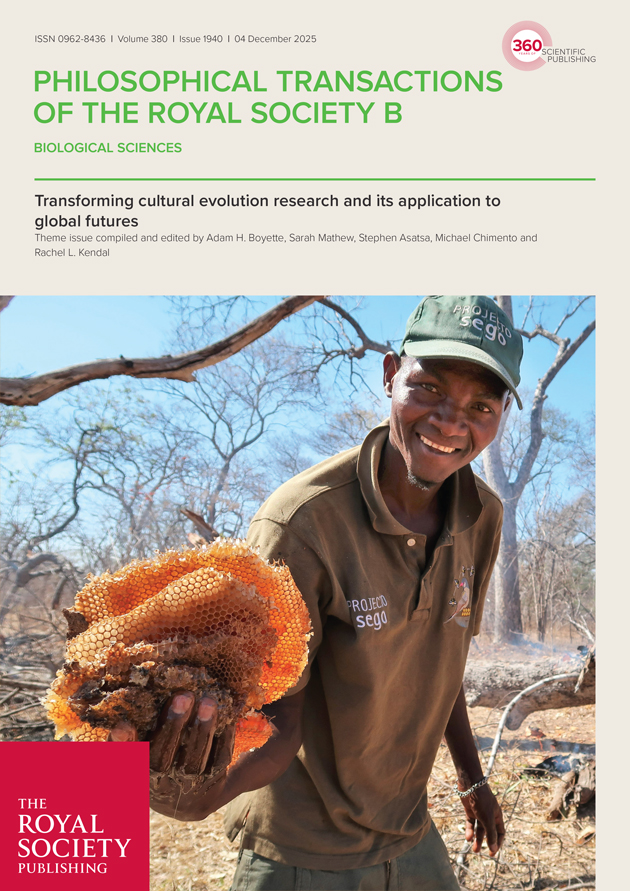
Read the theme issue ‘Transforming cultural evolution research and its application to global futures’.
Visit our website to read more content from Philosophical Transactions B, or to find out how you can become a Guest Editor for the journal.