
Since Biology Letters launched in 2005, the journal's community of scientists across career stages has grown around the world. At the core of this community are the future leaders in their fields, early career researchers, who may be starting to submit their studies for publication the first time.
With this in mind, Biology Letters launched the Early Career Researcher Competition in 2022 that opens each year in January. The overall winner of the best published research article receives £1000 and the two runners-up receive £500 each (or currency equivalent). We hope the prizes are particularly helpful for supporting the recipients’ continued excellence in their field.
2025 Competition winners announced
The competition saw fantastic entries for the 2025 prize. You can see all of these on this special collection page.
2025 Winner
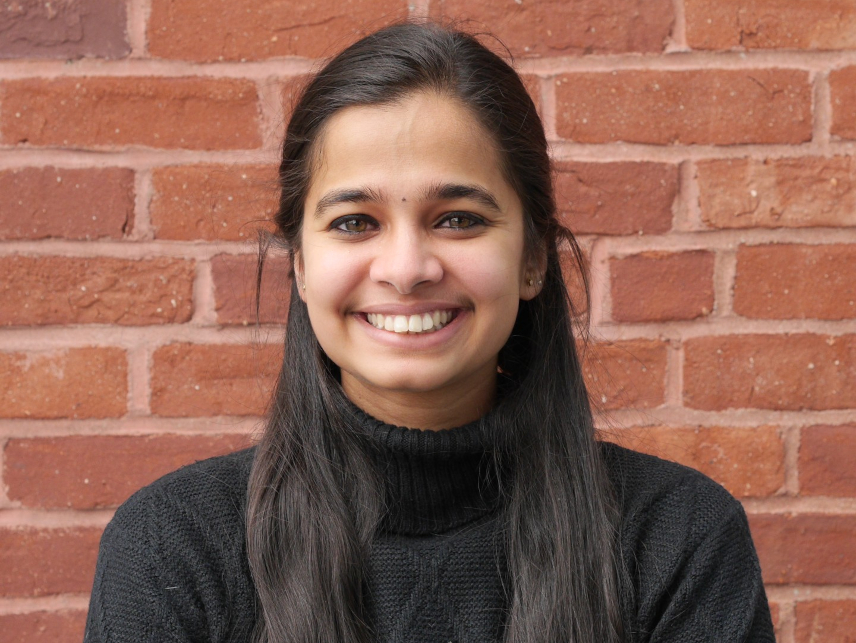
We are excited to announce that the winner of the 2025 competition is Gayathri Kondakath for the research article Caterpillars suppress nocifensive behaviours during the quiescent ‘sphinx’ state.
2025 Runners-up
Chase Brownstein for the research paper Night lizards survived the Cretaceous–Palaeogene mass extinction near the asteroid impact.
Aditya R Kurre for the research paper Lost giants, lost functions: palaeodietary insights into the ecological niches of Pleistocene ground sloths.
Arlo Hinckley for the research paper Uncovering new lineages in the Sunda pangolin (Manis javanica) with museum mitogenomics.
2026 Competition
The 2026 competition will reopen in January. For more information, take a look at the terms and conditions. If you have any questions, please contact the editorial office (biologyletters@royalsociety.org) at any time.
Past winners
2024 Winner
Jose Borrero for the research article Weighting of sensory cues reflect changing patterns of visual investment during ecological divergence in Heliconius butterflies.
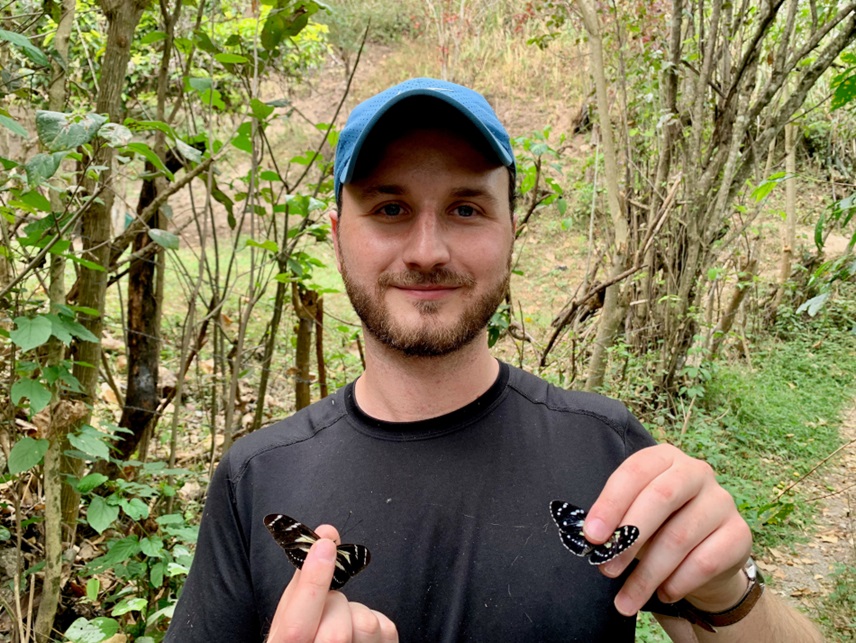
“I was pleasantly surprised and honoured to be a finalist. Being recognized for our work was incredibly rewarding. This paper involved a great deal of effort, particularly in training the (sometimes stubborn) butterflies. I really recommend other early career researchers to enter the competition. It’s a great opportunity to gain recognition and share your work with a wider audience.”
Visit our blog for a discussion with Jose Borrero about his winning paper.
2024 Runners-up
Ruby Stephens for the research paper Zygomorphic flowers last longer: the evolution of floral symmetry and floral longevity. Read our blog post for a discussion with Ruby Stephens about her research.
Daniel J Leybourne for the research paper Genetic diversity in vector populations influences the transmission efficiency of an important plant virus. Visit our blog to read a discussion with Daniel J Leybourne about his paper.
2023 Winner
Joe Wynn for the research article Naive songbirds show seasonally appropriate spring orientation in the laboratory despite having never completed first migration.

In the winning paper, the authors show that naïve birds that have likely never left their breeding site show seasonally-appropriate spring migratory orientation, suggesting that there is likely an inherited component to spring migration. The judges found this to be a striking and unexpected result with a nicely designed study system.
Joe notes; “It’s always funny seeing how other people see you – and how their valuations of your work differ from your own – and it’s very rare that the papers I think are good that other people appreciate. To that end, I would always encourage people to be optimistic and positive when it comes to their research (including with regards to competitions!)”.
Visit our blog for a discussion with Joe Wynn about his winning paper.
2023 Runners-up
Ana Valenzuela Toro for the research article Feeding morphology and body size shape resource partitioning in an eared seal community. Visit our blog to read a discussion with Ana Valenzuela Toro about her paper.
Antoine Guiguet for the research article Extreme acidity in a cynipid gall: a potential new defensive strategy against natural enemies. Read our blog post for a discussion with Antoine Guigue about their research.
Related content


In Publishing
2 min read
Biology Letters Early Career Researcher Competition – 2024 finalists: Jose Borrero
The journal Biology Letters recently launched its 2025 Early Career Researcher Competition. We…

In Publishing
2 min read
Biology Letters Early Career Researcher Competition – 2024 finalists: Ruby Stephens
The journal Biology Letters recently launched its 2025 Early Career Researcher Competition. We…

In Publishing
3 min read
Biology Letters Early Career Researcher Competition – 2024 finalists: Daniel J. Leybourne
The journal Biology Letters recently launched its 2025 Early Career Researcher Competition. We…

Surayya Johar
In Publishing
2 min read
Biology Letters Best Paper Prize – 2023 finalists: Joe Wynn
An interview with the overall winner of the Biology Letters Best Paper Prize 2023 competition.

Surayya Johar
In Publishing
4 min read
Biology Letters Best Paper Prize – 2023 finalists: Ana Valenzuela Toro
In this first post, we hear from one of last year’s finalists about their research.

Surayya Johar
In Publishing
3 min read
Biology Letters Best Paper Prize – 2023 finalists: Antoine Guiguet
In our second post, we hear from another of last year’s finalists about their research.