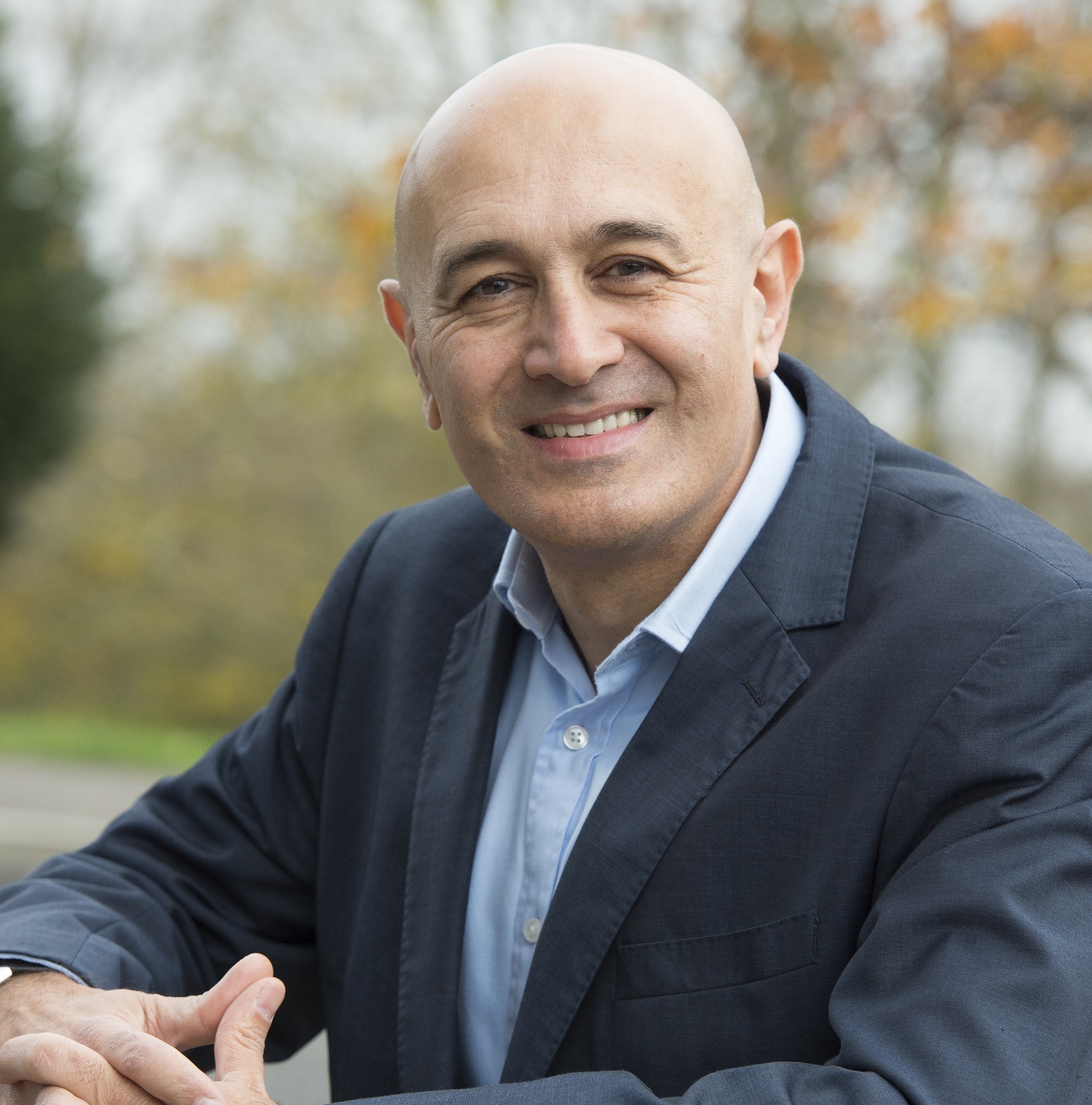
Jim Al-Khalili is a theoretical physicist and currently Distinguished Professor Emeritus in Physics at the University of Surrey. He received his PhD in nuclear reaction theory in 1989 and has published widely in the field. His current research interests are in open quantum systems, the application of quantum mechanics in biology and the foundations and history of quantum mechanics. In 2018, he helped establish at Surrey the world’s first doctoral training centre in quantum biology and, in 2020, set up a new Quantum Foundations Centre.
Jim is a prominent author and broadcaster. He has written 16 books on popular science and the history of science, between them translated into twenty-six languages. Two of his books (Life on the Edge: The Coming of Age of Quantum Biology and The World According to Physics) were shortlisted for the Royal Society Trivedi and Winton Prizes, respectively. He is a regular presenter of TV science documentaries, such as the Bafta nominated Chemistry: a volatile history, and he hosts the long-running weekly BBC Radio 4 programme, The Life Scientific.
Jim is a past president of the British Science Association, an honorary fellow of the Royal Academy of Engineering and a recipient of the Royal Society Michael Faraday medal and the Wilkins-Bernal-Medawar Medal, the Institute of Physics Kelvin Medal and the Stephen Hawking Medal for Science Communication. He received an OBE in 2007 and a CBE in 2021 for 'services to science’.
Professional position
- Distinguished Professor Emeritus of Physics, Department Of Physics, University of Surrey
Subject groups
-
Other
History of science, Public engagement, Science policy
-
Mathematics
Applied mathematics and theoretical physics
-
Astronomy and Physics
Biophysics, Nuclear, atomic and molecular physics, Quantum theory
Awards
-
Michael Faraday Prize and Lecture
-
Wilkins-Bernal-Medawar Medal and Lecture
He is a sought-after broadcaster on scientific topics in all media. He is renowned for explaining complex ideas in modern physics in an approachable way, always with a strong sense of historical context. His contributions to televised histories of electricity, quantum physics and work in quantum biology are all noteworthy. His work ranges from very recent history of science to the far longer history of Arabic science.